





It focuses on reaching the right audience, increasing visibility, driving engagement, and converting traffic into measurable business growth through data-driven strategies.
Every small business owner eventually asks the same question: should I invest in SEO, run Google Ads, or do both? The debate over SEO vs paid ads isn’t new, but in 2026 with rising ad costs, AI-powered search results, and tighter marketing budgets the decision matters more than ever.
This guide breaks down Google Ads vs SEO using real 2026 data, compares organic vs paid search performance, and gives you a practical framework for deciding where your next marketing dollar should go.
Is SEO Better Than Paid Ads For A Small Business?
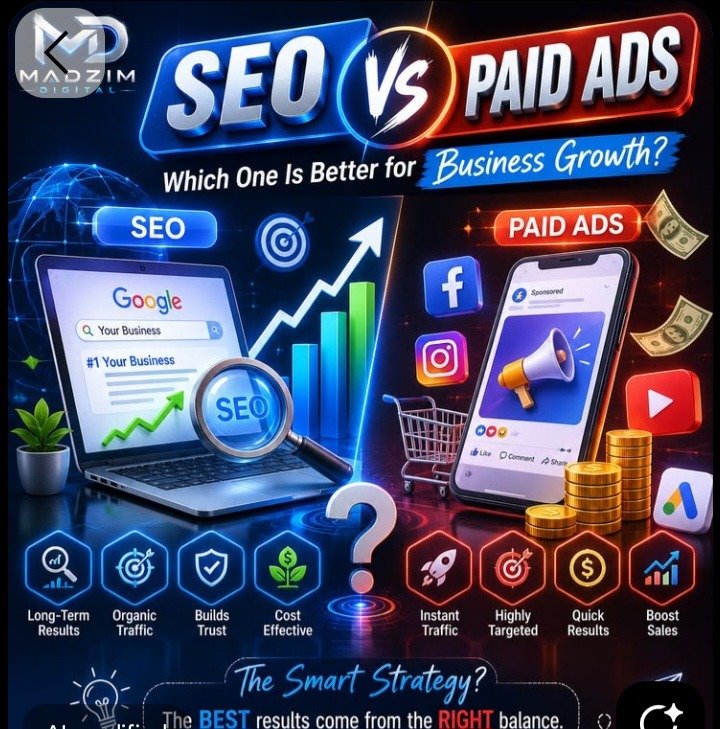
It depends on your timeline. SEO generally delivers better long-term ROI and lower cost per lead, while paid ads deliver faster results. Most small businesses benefit from using both.
What Is Search Engine Optimization (SEO)?
Search Engine Optimization (SEO) is the process of improving your website so it ranks organically without paying per click in search engines like Google. It covers technical site health, keyword-targeted content, backlinks, and local signals like your Google Business Profile.
SEO doesn’t produce instant results. It’s a compounding asset: once a page ranks, it can keep generating free traffic for years. For a deeper walkthrough of the fundamentals, Stratvora’s beginner’s guide to small business SEO is a solid starting point.
What Are Paid Ads (Google Ads)?
Paid ads most commonly Google Ads let you buy visibility at the top of search results, on YouTube, or across the Display Network. You bid on keywords, and Google runs a real-time auction each time someone searches, weighing your bid alongside ad quality and relevance to decide if and where your ad appears.
The moment you stop paying, the traffic stops. For a walkthrough of campaign basics, Moreed Digital Solutions’ guide to digital marketing strategies for startups covers how to structure a Google Ads campaign alongside your broader marketing mix.
How Much Should A Small Business Budget For SEO vs Google Ads In 2026?
Local SEO typically costs $20–$40 per lead at maturity, versus $55–$110 per lead for local PPC. Many businesses start with a split budget and adjust based on which channel performs better for their niche.
SEO vs Paid Ads: Key Differences
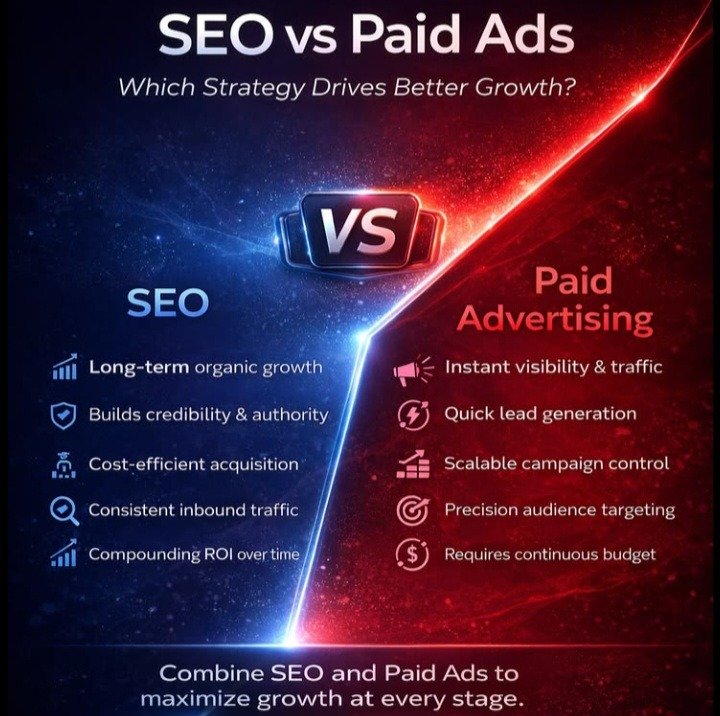
The organic vs paid search debate comes down to a handful of core trade-offs.
Cost structure differs fundamentally: SEO costs are front-loaded into content, technical work, and link building, while paid ads charge you continuously, per click. Time to results is the next big divide. Paid ads can start driving traffic within 1–7 days, while SEO typically needs 3–6 months or more before rankings move meaningfully.
That difference in speed maps directly onto longevity: SEO traffic compounds and keeps working long after the initial investment, while paid traffic stops the moment your budget runs out.
Performance also diverges. Organic traffic converts at roughly 2.4%, nearly double the 1.3% typical conversion rate for paid traffic, largely because organic visitors weren’t shown a “Sponsored” label and arrive with more built-in trust.
That trust advantage extends to control, though in the opposite direction: paid ads give you direct, immediate control over rankings through bidding, while SEO rankings are indirect and algorithm-dependent.
Finally, on scalability, paid ads can scale instantly (within your budget ceiling), while SEO scales slowly but steadily as your site accumulates authority.
In short: paid ads buy speed and control; SEO builds trust and a compounding, long-term asset.
Cost Comparison: SEO vs Paid Ads In 2026
Cost is usually the deciding factor for small businesses, and the 2026 numbers are telling.
Small and medium-sized businesses currently spend roughly seven times more on PPC than on SEO, largely because paid ads feel more immediate and controllable. But that spending gap doesn’t necessarily reflect better returns.
The average Google Ads cost-per-click sits around $4.22, though competitive industries like legal services can exceed $8.67 per click. SEO’s costs, by contrast, are concentrated upfront mostly content creation, link-building, and technical optimization rather than an ongoing per-click toll.
At the local level, the gap is even clearer. Local SEO for small businesses averages a $20–$40 cost-per-lead once campaigns mature, compared to $55–$110 per lead from local PPC. Over time, that gap widens further because SEO returns compound while PPC costs stay flat or climb.
For a full pricing breakdown by service tier, Stratvora’s SEO pricing guide for small businesses walks through what different budgets typically buy. If you’d like to see the raw numbers behind these comparisons, this 2026 SEO vs PPC statistics report is worth a look.
Speed vs Sustainability
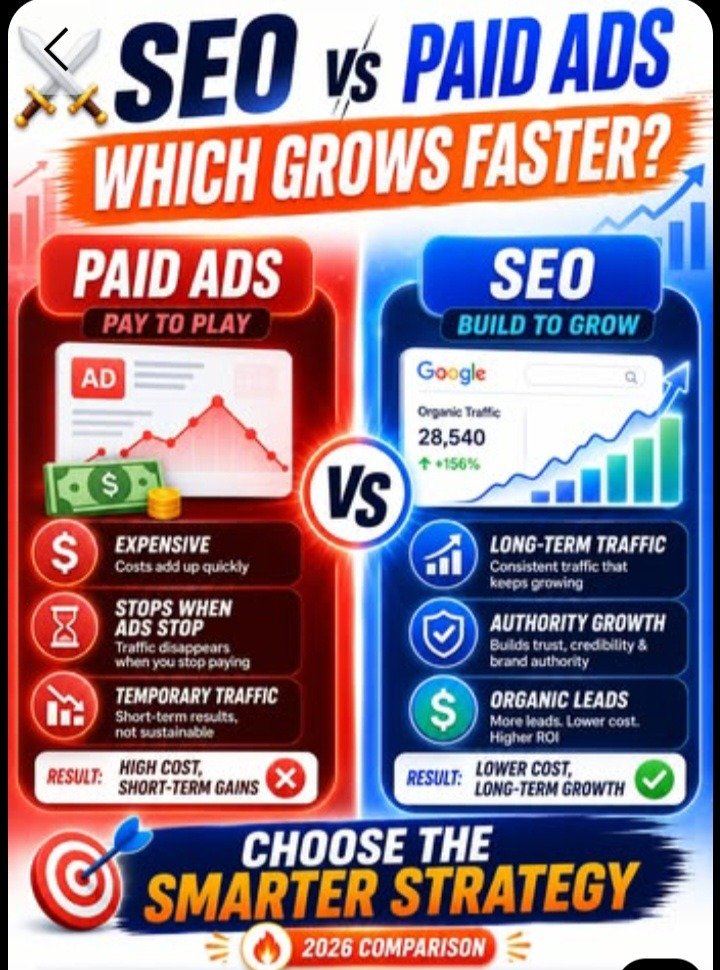
This is really the crux of SEO vs paid ads:
● Paid ads win on speed. PPC campaigns can generate leads within 1–7 days of launch, making them ideal when you need customers fast, a product launch, a slow season, or a new location opening.
● SEO wins on sustainability. Meaningful ranking improvements typically take 3–6 months to materialize, but once you rank, that traffic keeps arriving without an incremental cost per click.
One digital marketing agency case study illustrates this well: a local plumbing company spending $4,200/month on Google Ads was generating around 35 leads monthly at roughly $120 per lead but when they paused ads for two weeks during a cash flow crunch, leads dropped to zero, because their entire pipeline was rented rather than owned.
Pros And Cons Of SEO
Pros:
● Lower cost per lead over time
● Higher trust organic search drives 53% of all website traffic, (Search Scale AI) climbing to 57% for B2B companies (Search Scale AI)
● Compounding returns a ranked page keeps working for you
● Inbound leads (mostly organic search) cost 61% less than outbound leads from cold calling or direct mail (Search Scale AI)
Cons:
● Slow to show results
● No guaranteed rankings algorithm changes can shift positions
● Requires ongoing content and technical maintenance
Pros And Cons Of Paid Ads
Pros:
● Immediate visibility, often within days
● Precise targeting by location, device, demographics, and intent
● Easy to test, measure, and pause
Cons:
● Traffic disappears the moment you stop paying
● Costs can rise with competition CPCs in competitive niches like legal already exceed $8.67 per click
● Lower average conversion rate than organic traffic (1.3% vs SEO’s 2.4%)
When SEO Wins For Your Small Business
SEO tends to be the better long-term investment when:
● You’re building a business meant to last years, not months
● Your niche has manageable keyword competition
● You have the patience to wait 3–6 months for compounding results
● You want to reduce reliance on ongoing ad spend
SEO’s ROI is estimated to run about 25% higher than PPC’s, for many small businesses, largely because organic visitors arrive already trusting a result they weren’t shown as a paid ad.
Two well-known examples:Airbnb built much of its early growth on programmatic SEO through location pages long before it had a major ad budget, and HubSpot built its entire acquisition engine around content and organic search rather than paid media.
What’s The Difference Between Organic And Paid Search Results?
Organic results are earned through SEO and unpaid; paid results are ads you’re charged for per click, marked “Sponsored.”
Organic results generally earn more trust and click-through from users.
When Paid Ads Win For Your Small Business
Google Ads is often the smarter first move when:
● You need customers this week, not this quarter
● You’re testing a new offer, market, or landing page
● You’re in a highly competitive niche where organic ranking could take a year or more
● You have seasonal demand spikes to capture
Moreed Digital Solutions’ guide to the types of digital marketing breaks down how paid advertising fits alongside SEO, content, and social useful context before you pick a campaign approach.
Can I Do SEO And Google Ads At The Same Time?
Yes, and most marketing agencies recommend it. Paid ads generate leads immediately while SEO builds organic visibility that reduces ad dependency over time.
The Hybrid Approach: Why Most Businesses Shouldn’t Choose Just One
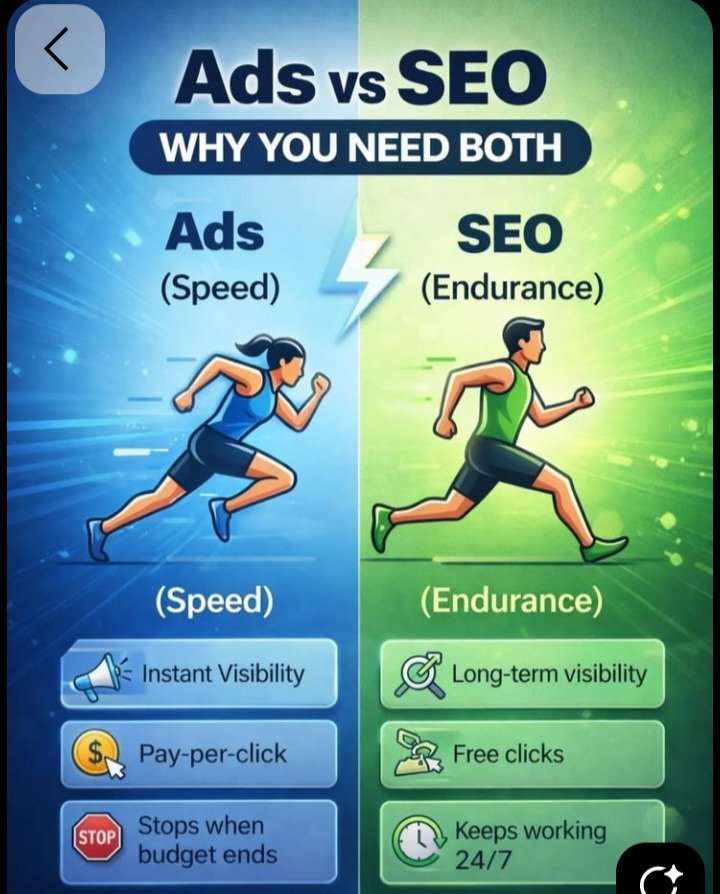
The smartest small businesses in 2026 aren’t picking a side in the Google Ads vs SEO debate; they’re running both, in a deliberate ratio based on stage and budget. PPC and SEO work best as complementary channels rather than competitors; the real question isn’t “which one” but “what ratio” given your business’s stage, budget, and timeline.
A practical split: use paid ads to generate leads immediately while SEO content and technical work build in the background.
One agency restructured a client’s budget from $4,200/month entirely on Ads to a split of $2,500/month on SEO and $1,700/month on a leaner, more targeted PPC campaign accepting a short-term dip in leads while building a durable organic foundation.
This is also increasingly true given how search itself is changing. More than 75% of marketers expect to maintain or increase their search and display ad budgets in 2026, even as website, blog, and SEO content remain the top ROI performer at 27%, ahead of email marketing at 22%.
For a framework on splitting budget between the two, Moreed Digital Solutions’ local SEO strategy guide lays out a practical 70-20-10 budget allocation rule 70% to what’s already working, 20% to optimization, and 10% to experiments that applies well to splitting SEO and paid ad spend.
For a framework on splitting budget between the two, MoreedDigitalSolution’s marketing budget allocation guide is a helpful companion to this article.
Which Is Faster: SEO or Paid Ads?
Paid ads. Google Ads can generate leads within a week of launch, while SEO typically takes 3–6 months to show measurable ranking improvements.
A Simple Decision Framework
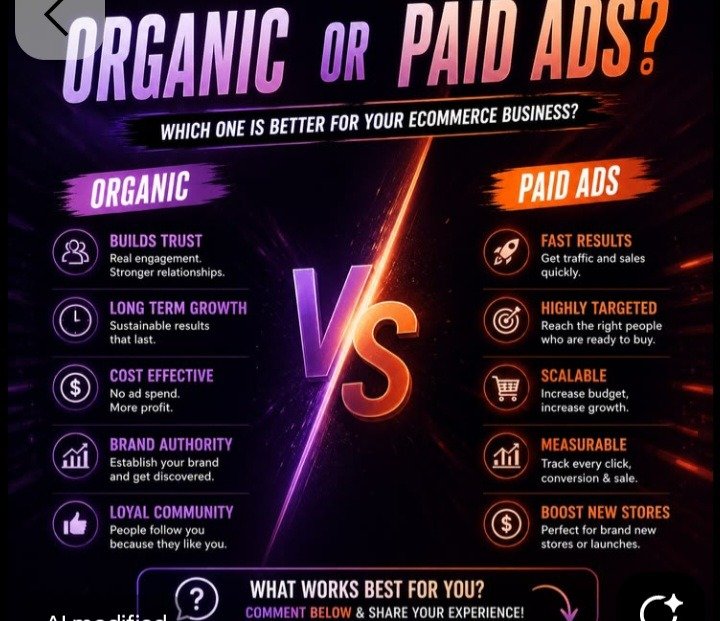
Ask yourself these questions before allocating budget:
● How soon do I need customers? Days paid ads. Months are fine SEO.
● What’s my budget ceiling? Under $1,000/month SEO content usually stretches further. Flexible budget hybrid.
● How competitive is my keyword space? Low competition SEO can win fast. Saturated market paid ads may be necessary just to get visibility.
● Am I testing or scaling? Testing a new offer paid ads. Scaling an established one SEO compounds the gains.
● What’s my customer lifetime value? High LTV businesses (legal, home services, B2B) can absorb higher CPCs and often benefit from running both channels simultaneously.
If you want to see how Google frames its own platform’s mechanics before committing a budget, the official Google Ads Help Center is a good primer directly from the source.
Do Paid Ads Help My SEO Rankings?
Not directly Google Ads and organic rankings are separate systems. However, paid ads can send useful data (which keywords convert) that informs your SEO content strategy.
Conclusion
There’s no universal winner in the SEO vs paid ads debate. The right answer depends on your timeline, budget, and competitive landscape.
Paid ads deliver speed; SEO delivers sustainability and, over the long run, typically a lower cost per lead.
For most small businesses in 2026, the winning strategy isn’t choosing one over the other, it’s using paid ads to generate momentum today while SEO builds the compounding, low-cost growth engine that carries the business forward for years.